
Entropic Behaviors: Group Project Grading
You get a B-! And you get a B-! And you!

Leaders adapt to prioritize their time and energy toward the most urgent problems, and most of those adaptations are responses to very real constraints. There is almost always too much going on inside of an organization for a leader to have their hands in everything (and it wouldn’t be healthy if they did!). Some of the most common of these adaptive behaviors include being rapidly decisive, limiting attention to the highest-impact pieces of work, and orienting around outcomes rather than process details. In environments with limited resources and lots of “work” happening, these behaviors aren’t just useful, they are often necessary for survival.
However, when these approaches are applied too broadly and without careful consideration, they can allow cracks in functions and breaches in alignment - the “entropy” mentioned in my prior articles - to quietly expand beneath the surface. What began as appropriate executive prioritization becomes overgeneralization, and over time that overgeneralization creates subtle but meaningful distortions in how credit, accountability, and influence are distributed.
Welcome to the new entropic behaviors series, where I will be exploring approaches to management and leadership that can be adaptive in many contexts but can also foster entropy when over-applied. These aren’t inherently bad behaviors. In fact, they are often strengths. The risk emerges when a useful shortcut becomes the default lens through which everything is interpreted. We’ll start our exploration with a particularly common and tempting shortcut: group project grading.
“Group project grading” refers to the tendency to treat the outcome of an initiative as the collective product of everyone involved, whether by name, title, or proximity to the effort, and to assign credit or blame accordingly. It is a shorthand evaluative move that prioritizes the visible result (success or failure) over the internal mechanics of how that result was achieved and evaluating who meaningfully contributed to it.
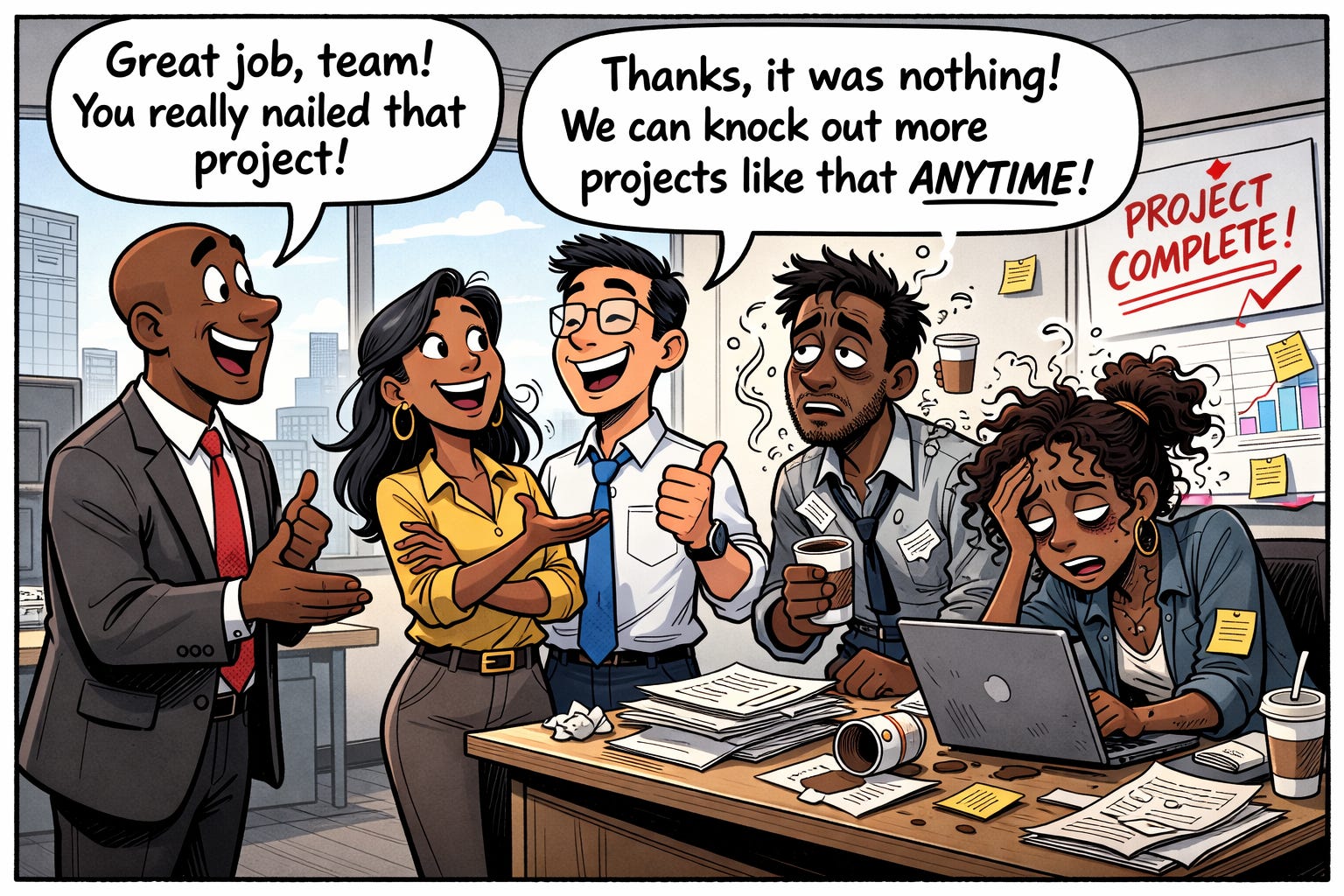
From an executive perspective, group project grading is extremely efficient! It reduces complexity into a single question: did the group get the work done. If a project goes well, everyone did well, and if a project goes poorly, group heads may roll. At the leadership and executive level, outcomes are often what is most relevant, particularly when time and attention are scarce and there are dozens of other decisions competing for cognitive bandwidth. Getting into granular details, especially when a project succeeded, can feel unnecessary or even indulgent. After all, the work got done, right?
My name for this phenomenon intentionally parallels how group projects can be graded in school, and that parallel is more than just me entertaining myself. It’s a reminder of how frustrating and unfair group grading practices at work can feel to those on the ground, as experienced by anyone who has ever carried a group project while others benefited equally from the final grade.1 The emotional memory of that imbalance is familiar to most of us, and yet in professional settings we often recreate the same dynamic under the banner of efficiency.
If a project is successful, two kinds of important information can be lost in the ensuing celebration. First, whether there were individuals who did disproportionate work to carry the project across the finish line, often compensating for gaps elsewhere in the system. If this continually occurs over time, your system becomes extremely reliant on the people who are informally filling gaps, potentially discouraging their participation without proper recognition, and risking the system itself should the gap-fillers ever choose to opt out. Second, whether there were noncontributors who, by virtue of association, are gaining credibility and reputation because of the overall success. When these distortions repeat over time, incentives shift subtly but meaningfully, and influence accrues to people who may not actually be driving positive outcomes.
If a project fails, the damage is no less real. Those who didn’t contribute are now (hopefully) blamed appropriately. However, individuals who not only did their jobs but went above and beyond to mitigate risk, solve problems, or support teammates may lose social capital and reputation despite being precisely the kind of people you want stepping into complex or unstable situations in the future. When strong contributors are repeatedly grouped into undifferentiated failure assessments, the organization risks discouraging initiative, resilience, and discretionary effort.

In both scenarios, entropy accumulates not because leaders are indifferent, but because the evaluation system is too blunt to capture the nuances of contribution, effort, and accountability that actually shape performance over time.
Resolving group project grading can feel daunting if the only imagined solution is for the executive to become personally embedded in every project, reviewing every conversation and validating every individual’s contributions. That kind of indiscriminately close management style is neither scalable nor desirable, and it would create its own form of dysfunction.2 Leaders can’t be the daily “are you contributing” police, but they should have appropriately calibrated visibility into project efforts as well as their outcomes.
Fortunately, practical solutions to this problem already exist. Project and responsibility tracking software is now fairly ubiquitous in business environments of all sizes, and while they are often implemented for coordination rather than evaluation, they also provide a structural antidote to undifferentiated grading. You can’t reasonably spend hours interviewing people to determine who is doing what, but you absolutely can, and should, periodically review overall tracking boards and ownership assignments to understand where work is accumulating, where bottlenecks are emerging, and how responsibilities are distributed.
If you have dedicated project managers, you can rely on those individuals to share or produce reports regarding progress, ownership clarity, and contribution patterns. Leveraging those roles for structured visibility isn’t micromanagement; it is an appropriate use of governance mechanisms that already exist within the organization. Coordinating regularly with your project managers and gaining on-the-ground insights into contributions meaningfully reduces the risk of misattributed credit or blame at the cost of no more than, say, a few minutes a week for each major initiative under your purview.
If you are operating within a smaller business that does not have sophisticated tooling or a formal PM function, the same principles still apply at a lighter weight. Referring back to clearly defined ownership, documented responsibilities, and internal communications can provide sufficient clarity to avoid defaulting to group grading. Even simple written updates in work communication apps (like Slack or Google Docs) create an evidentiary trail that distinguishes effort and engagement without requiring additional meetings.
There is also quite a lot available to the modern business by way of post-project analysis. Project retrospectives, often associated with Scrum and Agile workflows but adaptable to nearly any operational context,3 offer a structured way for leaders to gather a single artifact reflecting how a project unfolded. An executive can implement this practice directly or delegate facilitation to a project manager or trusted team member4, with the goal of capturing not only what went well and what did not, but how roles were experienced and where contributions diverged from expectations. For smaller companies or organizations without continuous tracking mechanisms, a well-run retrospective is an especially efficient investment because it concentrates insights about contributions5 into one contained moment of reflection.
Where formal systems just aren’t feasible, listening is an always available (and frequently underutilized) tool. Maintaining open feedback avenues and creating conditions in which people feel safe sharing concerns about workload imbalance or credit allocation can surface entropy early, before it becomes culture. If you have built trust and demonstrated that you respond responsibly and fairly to feedback, people will often provide the information you need without being prompted.
The encouraging reality is that addressing group project grading doesn’t require leaders to make a disproportionate time investment or constantly immerse themselves in the details. With calibrated systems, periodic structured review, and a culture that values accurate attribution, leaders can get the best of both worlds, preserving their own efficiency while preventing or reducing entropy. As this series continues, we will explore additional entropy risks and the practical ways to navigate them without sacrificing the strengths that made them appealing in the first place.
If you haven't been there, you've either been ridiculously fortunate in the groups to which you were assigned (or that you selected) when you were in school, or, you're the problem.
Why yes, I do already have the "micromanagement" article in the works!
What went well in that PvP raid? What went poorly? What ideas should we try next time? Yes, I have done a retro for a gaming group, and I regret nothing!
For what it's worth, I do highly recommend delegating this work, as behavior fundamentally changes once senior leaders become involved.
As well as MANY other types of insight: a retrospective is an invaluable tool when implemented well. Even if executives don't regularly review them, they can help teams identify what processes worked and didn't.